

What is Temple Hair Loss?
Temple hair loss occurs when patients begin to notice thinning or balding on the sides of their head, which makes up a significant portion of the hairline. In men, hair loss focused at the temples can be the first sign of androgenic alopecia and can lead to a receding hairline.
When the hairline recedes enough, it forms a V-shape or creates a deep widow’s peak. Women may also experience temple hair loss as a result of traction alopecia, stress, or other factors.
At Aesthetic Scalp in Chicago, our board-certified doctors use a long hair technique to place hairs on the temple. Since this skin is smoother than the rest of the scalp, hair restoration in this area can be more difficult. However, hair specialists Drs. Anil Shah and Sameea Chughtai are highly experienced when it comes to restoring the hairline and placing hairs in a way that encourages ongoing growth and thickness.

What are the causes of temple hair loss?
The causes of temple hair loss can vary tremendously, especially when comparing men and women. In men, temporal baldness is most often caused by androgenic alopecia, also called male pattern baldness. Hair loss at the temples is often the first indication of hereditary-pattern baldness in men and often leads to a deep widow’s peak.
Since women experience hereditary-pattern baldness differently than men, their temples are not always affected. Instead, women may experience temporal hair loss as a result of traction alopecia (caused by wearing tight ponytails or hairstyles), stress, tobacco use, hormonal changes as a result of pregnancy or menopause, certain medications, or vitamin deficiencies.
Signs of Temple Hair Loss
The temples are located on the sides of the head and make up a significant portion of the hairline. Sometimes, it’s easy to tell when hair loss occurs in this area because the hairline is very visible. Patients with temple hair loss may notice the development or deepening of a widow’s peak or a V-shaped hairline.
While it’s normal to lose up to 100 hairs throughout the day, people with hair loss may notice large chunks of hair falling out when they shower or brush their hair. If you suspect that you may have temple hair loss, we encourage you to call our Chicago office because this type of thinning may be the first indicator of androgenic alopecia (hereditary-pattern baldness).
Am I a Candidate For Treatment?
The ideal candidate for temple hair loss treatment typically experiences noticeable thinning at the sides of the hairline, whether from genetic factors, lifestyle influences, or medical conditions. If you’ve observed a receding hairline that’s beginning to form a widow’s peak — or noticed that your temples appear significantly thinner than the rest of your scalp — you may benefit from our advanced restoration techniques. Candidates should be in generally good health, have realistic expectations, and possess adequate donor hair in other areas of the scalp.
Temple Hair Loss Before & After Results
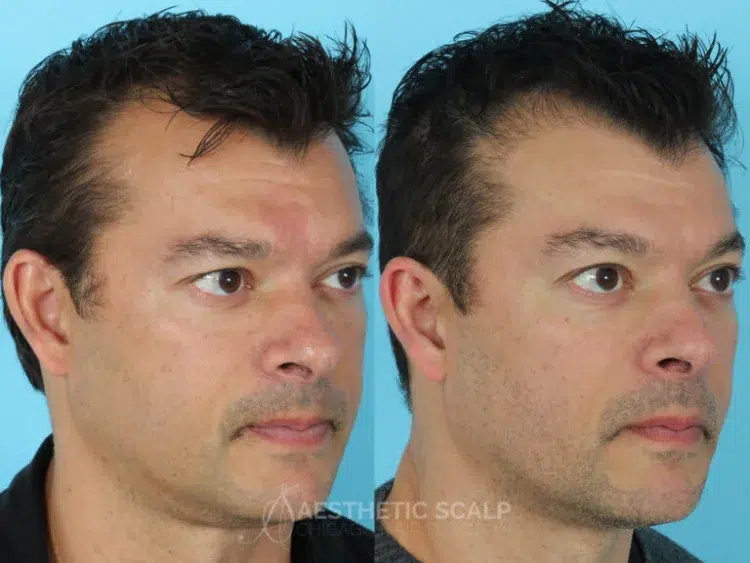
Treatment for Temple Hair Loss
At Aesthetic Scalp, our board-certified doctors take special care to restore hair on the temporal region of the scalp. To address this slicker, less dense area, Drs. Shah and Chughtai perform advanced robotic surgery paired with regenerative techniques to replenish our patients’ hairlines and encourage natural, ongoing hair growth for years to come. When placing hairs for patients with temporal hair loss, we use an approach called the long hair technique, which requires people to keep their central hair long while the temples are regrowing.
This allows the area to fill in over time and enables the new hairs to germinate. Once the new hairs have been placed, we then use nonsurgical techniques (like PRP therapy) to facilitate the strengthening of the hair follicles. By combining surgical hair restoration with regenerative techniques, this creates an optimal environment for the procedure to succeed and encourages long-lasting results.
Catching the signs early is key
Since the temples make up a portion of the hairline and are visible for most hairstyles (especially in men), it can be very noticeable when the hair in this area begins to thin or fall out completely. Thankfully, men and women with temple hair loss have a range of options available to them to help restore their hairline. Our team at Aesthetic Scalp uses a range of advanced techniques and state-of-the-art technology to help people of all ages, genders, and ethnic backgrounds achieve a hairline that looks natural and attractive.
About Dr. Shah and Dr. Chughtai
Dr. Anil Shah brings nearly two decades of specialized expertise as a double board-certified facial plastic surgeon to every temple hair loss case at Aesthetic Scalp. His comprehensive training includes advanced fellowships in facial plastic and reconstructive surgery at prestigious institutions like NYU and Cornell, giving him an unparalleled understanding of facial aesthetics and the delicate anatomy surrounding the temporal region. As the only Chicago hair surgeon offering ARTAS® robotic hair restoration technology, Dr. Shah combines surgical precision with artistic vision to recreate natural-looking hairlines that complement each patient’s unique facial structure.
Dr. Sameea Chughtai has established herself as a leading hair restoration expert with over a decade of focused experience treating both male and female pattern baldness. Her board certification in family medicine, combined with specialized training in regenerative medicine and hormone therapy, allows her to address the underlying causes of temple hair loss. Dr. Chughtai’s personal experience with hair loss gives her unique insight into the emotional impact that thinning temples can have on patients’ confidence, and her expertise in PRP therapy and exosome treatments has helped countless patients achieve fuller, healthier hair growth.
After Your Temple Hair Loss Treatment
Most patients experience minimal downtime and can return to work within a few days, though strenuous exercise should be avoided for two weeks during the healing process. Initial recovery often involves mild redness and swelling that resolves naturally. New hair growth typically appears around three to four months post-treatment, with substantial results visible by six to nine months.
How Much Does It Cost to Treat Temple Hair Loss?
The cost of treating temple hair loss depends on your specific needs and the techniques you choose. The price of your Chicago hair restoration will be determined during your consultation. We also offer flexible financing options to help patients manage the cost of care.
Temple Hair Loss FAQ
Is it possible to create a natural-looking hairline?
Creating a natural hairline is one of the most important aspects of our hair loss procedures at Aesthetic Scalp. Our team meticulously plans each treatment to provide excellent results that don’t appear “worked on.”
How much pain is involved?
Aesthetic Scalp takes every precaution to minimize pain and discomfort during your procedure. We use a local anesthetic to the treatment area and provide oral medication as needed. Patients may also experience minor side effects during recovery.
What about nonsurgical solutions in Chicago, IL
Sometimes patients turn to prescription medications or creams to resolve hair loss. However, these over-the-counter solutions are not only unpredictable but not tailored to your needs. They may not be the best solution for hair loss on the temple.
Schedule a Temple Hair Loss
Treatment Consultation
If you’re concerned about temple hair loss in Chicago, contact Aesthetic Scalp today to schedule your consultation with Dr. Shah or Dr. Chughtai. Our team will design a personalized treatment plan to restore your hairline and confidence.
Schedule a Consultation
Related Procedures
Temple hair restoration requires precision — our team uses FUE, ARTAS® robotic techniques, and PRP therapy to rebuild natural framing and density along the hairline and temples.
Videos
Watch Dr. Anil Shah and Dr. Sameea Chughtai share insights on the eyebrow transplant process, from graft design to healing and final results. These videos from Aesthetic Scalp Chicago highlight their precise technique, artistry, and real patient transformations in facial hair restoration.